Future Home Entertainment: 4 Immersive Experiences for Americans in 2026
The latest developments on The Future of Home Entertainment: 4 Immersive Experiences for Americans in 2026 reveal significant shifts in how audiences will engage with media. Key facts highlight virtual reality, interactive narratives, personalized streaming, and holographic technologies. This report outlines what these changes mean for American households.
The landscape of The Future of Home Entertainment: 4 Immersive Experiences for Americans in 2026 is rapidly taking shape, driven by unprecedented technological innovation. This article provides a comprehensive overview of the transformative trends that are poised to redefine leisure and media consumption in homes across the United States. We delve into the specifics of four groundbreaking immersive experiences, offering context and verified analysis.
As we approach 2026, the convergence of high-speed internet, advanced computing, and creative content development is creating a new paradigm for home-based entertainment. These upcoming experiences promise not only greater immersion but also unprecedented levels of personalization and interaction. Understanding these shifts is crucial for consumers and industry stakeholders alike.
Virtual Reality: The New Frontier of Immersion
Virtual Reality (VR) is emerging as a cornerstone of the future home entertainment experience, moving beyond niche gaming into mainstream adoption. By 2026, more affordable and user-friendly VR headsets are expected to be commonplace in American homes, offering unparalleled escapism and engagement. This widespread availability will unlock a new dimension of digital interaction.
The advancements in VR technology include lighter headsets, improved resolution, wider fields of view, and more intuitive controls, making prolonged use comfortable and natural. This evolution addresses previous barriers to entry, paving the way for VR to become an integral part of daily life. The content ecosystem is also expanding rapidly, offering diverse experiences.
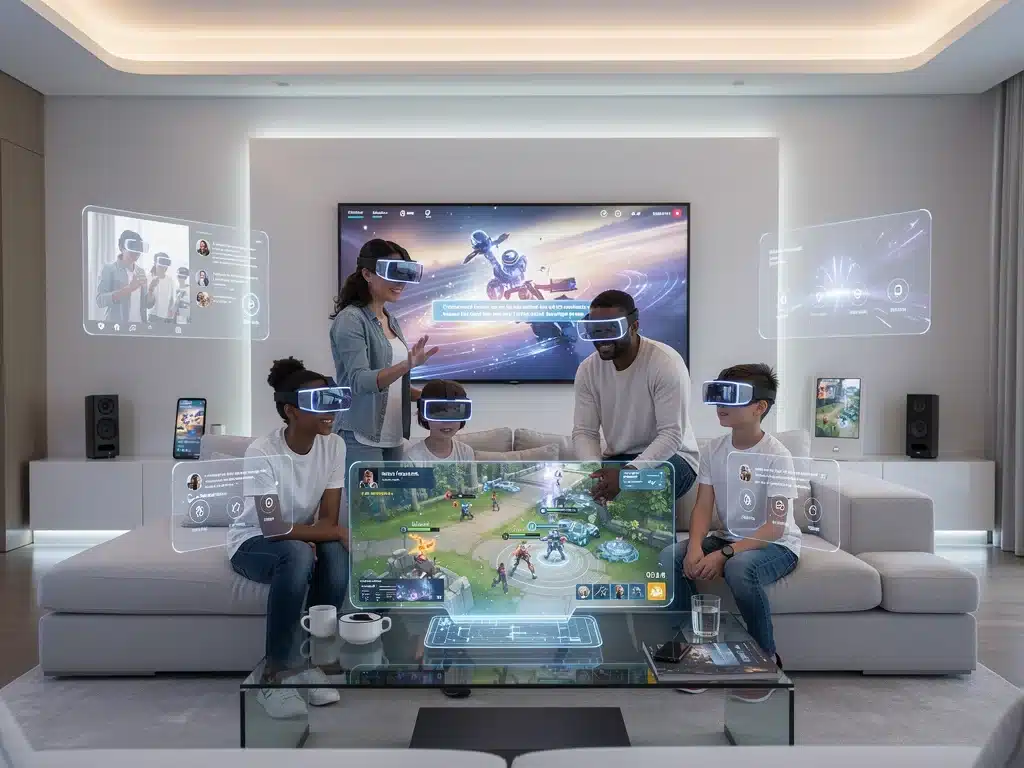
From hyper-realistic gaming worlds to virtual travel destinations and interactive educational programs, VR is set to transform passive viewing into active participation. Developers are focusing on creating social VR platforms where friends and family can gather in shared virtual spaces, blurring the lines between physical and digital interaction and defining a significant aspect of the future home entertainment experience.
Enhanced Gaming and Social Spaces
VR gaming is experiencing a renaissance, with titles offering deeper narratives and more responsive gameplay than ever before. Players will not just control characters; they will embody them, experiencing virtual worlds with a sense of presence previously unimaginable. This level of immersion redefines what it means to play a video game.
- Hyper-realistic graphics and haptic feedback systems.
- Multiplayer VR environments for shared experiences.
- Integration with AI companions for dynamic gameplay.
- Cross-platform compatibility for broader access.
Beyond gaming, social VR platforms are evolving into sophisticated digital meeting places. These spaces allow users to attend concerts, watch movies, or simply converse with others in custom-built virtual environments, fostering connection regardless of physical distance. These platforms are integral to the future home entertainment landscape.
Interactive Narratives: Beyond Passive Consumption
The era of passive content consumption is nearing its end, as interactive narratives become a dominant force in the future home entertainment sphere. Audiences are increasingly demanding agency over their viewing experiences, moving from spectators to active participants in stories. This shift empowers viewers to influence plotlines and character development.
Streaming platforms and content creators are investing heavily in technologies that allow viewers to make choices that directly impact the story’s progression. This extends beyond simple “choose your own adventure” formats, incorporating complex branching storylines and personalized endings. The goal is to create a unique experience for every viewer, every time.
This new wave of interactive content encompasses a wide range of genres, from thrillers and dramas to comedies and documentaries. The integration of real-time audience feedback and adaptive storytelling algorithms will ensure that no two viewing sessions are exactly alike, promising a truly dynamic and engaging future home entertainment experience for Americans.
Personalized Story Arcs and Viewer Agency
Interactive films and series will offer viewers the power to determine character fates, solve puzzles embedded within the narrative, and even alter the entire tone of a story. This deep level of engagement creates a profound connection between the audience and the content, transforming traditional storytelling models. The viewer becomes a co-creator of the narrative.
- Branching storylines with multiple outcomes.
- Real-time decision-making impacting plot.
- Integration with smart home devices for environmental cues.
- Community-driven narrative development options.
The success of these narratives hinges on seamless technology and compelling writing that encourages repeated viewings to explore all possible paths. This innovative approach to storytelling is central to the evolution of future home entertainment, providing a rich, personalized experience for every American household.
Personalized Streaming: AI-Driven Content Curation
Personalized streaming, powered by advanced Artificial Intelligence (AI), is set to revolutionize content discovery and consumption within the future home entertainment ecosystem. By 2026, streaming platforms will move beyond basic recommendation engines, offering hyper-tailored content experiences that anticipate individual preferences with remarkable accuracy. This represents a significant leap from current systems.
AI algorithms will analyze not only viewing history but also emotional responses, viewing patterns, and even biometric data (with user consent) to curate an ever-evolving stream of entertainment perfectly suited to each user. This deep level of personalization will reduce content fatigue and enhance overall satisfaction, making content discovery effortless. The goal is to present exactly what you want to watch, often before you even know you want to watch it.
This intelligent curation extends beyond movies and TV shows to include music, podcasts, interactive experiences, and even live events, all seamlessly integrated into a single, intuitive interface. The future home entertainment experience will be defined by its ability to adapt and evolve with the user, offering a truly bespoke media journey. Platforms will learn and grow with their audiences.
Adaptive Interfaces and Predictive Content
Streaming interfaces will become highly adaptive, displaying content in layouts and categories that resonate most with individual users. Predictive content loading will ensure instant playback, minimizing buffering and maximizing immersion. The entire user journey, from discovery to consumption, will be optimized for seamless engagement.
- Dynamic content carousels based on real-time mood analysis.
- Personalized trailers and synopsis generation.
- AI-driven content creation for short-form, tailored experiences.
- Seamless integration across all user devices.
Furthermore, AI will play a role in developing new content, identifying gaps in the market and even generating scripts or visual elements for short, personalized media. This symbiotic relationship between AI and content creation will push the boundaries of what’s possible in the future home entertainment landscape, offering an endless stream of novel experiences.
Holographic Displays: Bringing Content to Life
Holographic displays, once confined to science fiction, are on the cusp of becoming a tangible reality in the future home entertainment setup for Americans by 2026. These revolutionary displays will project three-dimensional images directly into living spaces, eliminating the need for screens and fundamentally altering how we perceive digital content. This technology promises to dissolve the barrier between content and reality.
Early iterations of home holographic projectors will offer impressive visual fidelity and a sense of presence unmatched by traditional screens. Imagine watching a sports event where players appear to be moving across your coffee table, or a movie scene unfolding in the center of your room. This technology redefines immersion, placing content directly within your environment.
While full room-scale holography might still be some years away, consumer-grade holographic devices will offer compelling experiences for gaming, education, and social interaction. These displays will not only enhance visual realism but also foster new forms of interactive storytelling and digital art, profoundly impacting the future home entertainment experience.
Spatial Computing and Immersive Environments
Holographic displays will be intrinsically linked to spatial computing, allowing users to interact with digital objects as if they were physically present. This enables new forms of augmented reality where virtual elements seamlessly blend with the real world, enhancing everyday activities and creating new entertainment possibilities. The boundaries between digital and physical will blur.
- Interactive holographic games played in your living room.
- 3D video calls with realistic avatars.
- Virtual fashion shows and product demonstrations.
- Educational content projected as tangible models.
The development of these displays will also spur innovation in content creation, with artists and developers exploring new ways to utilize three-dimensional space and light. The integration of haptics and directional audio will further enhance the illusion of reality, making holographic content a truly groundbreaking component of future home entertainment.
| Experience Type | Key Impact on Home Entertainment |
|---|---|
| Virtual Reality (VR) | Mainstream adoption of VR headsets for gaming, social, and educational content, offering deep immersion. |
| Interactive Narratives | Viewers become active participants in stories, influencing plotlines and character development with personalized outcomes. |
| Personalized Streaming | AI-driven content curation offering hyper-tailored recommendations and adaptive interfaces across all media types. |
| Holographic Displays | 3D images projected into living spaces, eliminating screens and blending digital content with the real world. |
Frequently Asked Questions About Future Home Entertainment
The future home entertainment landscape in 2026 is characterized by deeply immersive and personalized experiences. Key technologies include advanced virtual reality, highly interactive streaming content, AI-driven personalized recommendations, and the emergence of holographic displays, all aimed at enhancing user engagement and blurring reality’s lines.
By 2026, VR will move into mainstream American homes with more affordable and comfortable headsets. It will offer hyper-realistic gaming, virtual travel, and social platforms where users can interact in shared digital spaces, profoundly transforming how we engage with digital content and each other.
Interactive narratives represent a shift from passive viewing to active participation. Viewers will make choices that influence plotlines, character development, and story outcomes in films and series. This technology aims to create unique, personalized viewing experiences, enhancing engagement with content in the future home entertainment space.
AI will revolutionize personalized streaming by 2026, offering hyper-tailored content curation based on viewing history, emotional responses, and patterns. It will go beyond basic recommendations to anticipate preferences, integrating all forms of media into a seamless, adaptive interface that evolves with user tastes.
While full room-scale holography is still developing, consumer-grade holographic displays are expected to emerge by 2026. These will project 3D images directly into living spaces, offering immersive experiences for gaming, education, and social interaction without traditional screens, fundamentally changing how content is perceived.
Looking Ahead
The rapid evolution of The Future of Home Entertainment: 4 Immersive Experiences for Americans in 2026 signals a profound shift in how we interact with digital content. These advancements are not merely incremental improvements but represent foundational changes in user engagement, content delivery, and immersive technology. Monitoring the adoption rates of VR, the development of interactive content, the sophistication of AI-driven personalization, and the commercial viability of holographic displays will be crucial. These trends collectively point towards an era where home entertainment is more personal, more engaging, and more seamlessly integrated into our daily lives than ever before, shaping the cultural landscape for years to come.